Securing Digital Transformation in the Western Balkans
Article
Digital transformation is an ongoing process that has become ubiquitous worldwide. The main differences lie in how it is implemented based on the national environment and circumstances, and on the existent distinct implementation levels of nations.
Similarities nevertheless exist, especially when referring to the enablers and key components for success. One of these is cybersecurity, and as eGA’s Chairman Hannes Astok has stated: “Cybersecurity must therefore be at the core of the digital transformation – in the inception, implementation, and delivery of e-services and solutions, and a fundamental component of digital societies.”
However, this raises a fundamental question: how can cybersecurity and digital transformation be effectively benchmarked, and in what ways can these measurements be meaningfully related to one another in order to understand their mutual impact?
Indexing Digital Change
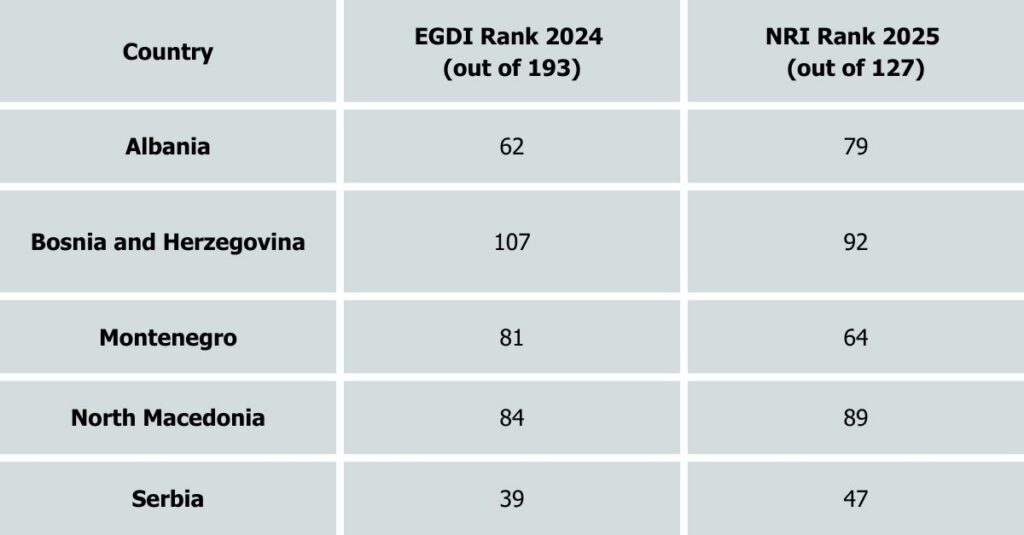
Digital transformation is not easily measurable, but there are at least two established international metrics: the E-Government Development Index (EGDI) and the Network Readiness Index (NRI), that can be used to obtain a relatively comprehensive screenshot of a nation’s efforts.
The United Nation’s EGDI presents the state of E-Government Development of the United Nations Member States. The EGDI is a composite measure of three important dimensions of e-government, namely: provision of online services, telecommunication connectivity and human capacity.
On the other hand, published by Portulans Institute, the 2025 NRI is the seventh edition of a renewed NRI model, reflecting how technology and people need to be integrated within an effective governance structure in order to have the right impact on the economy, society and the environment. The NRI is grounded in four fundamental dimensions: Technology, People, Governance, and Impact.
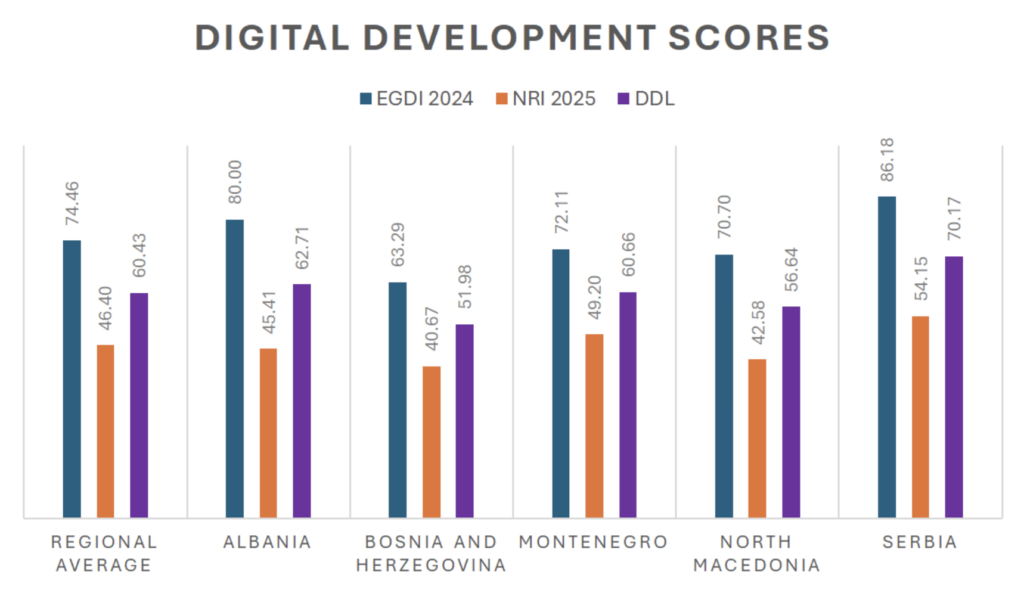
Additionally, eGA’s National Cyber Security Index (NCSI) builds upon the relationship between cybersecurity and digital development by creating a composite value, the Digital Development Level (DDL), which is contrasted with the nation’s cybersecurity efforts. The DDL is calculated according to the EGDI and the NRI, as the average percentage the country received from the maximum value of both indexes.*
Securing Digital Transformation
The NCSI is a global live index, which measures the preparedness of countries to prevent cyber threats and manage cyber incidents.
The NCSI is also a database with publicly available evidence materials and a tool for national cyber security capacity building. Among the evidence materials, the NCSI showcases the EGDI, NRI and DDL values.
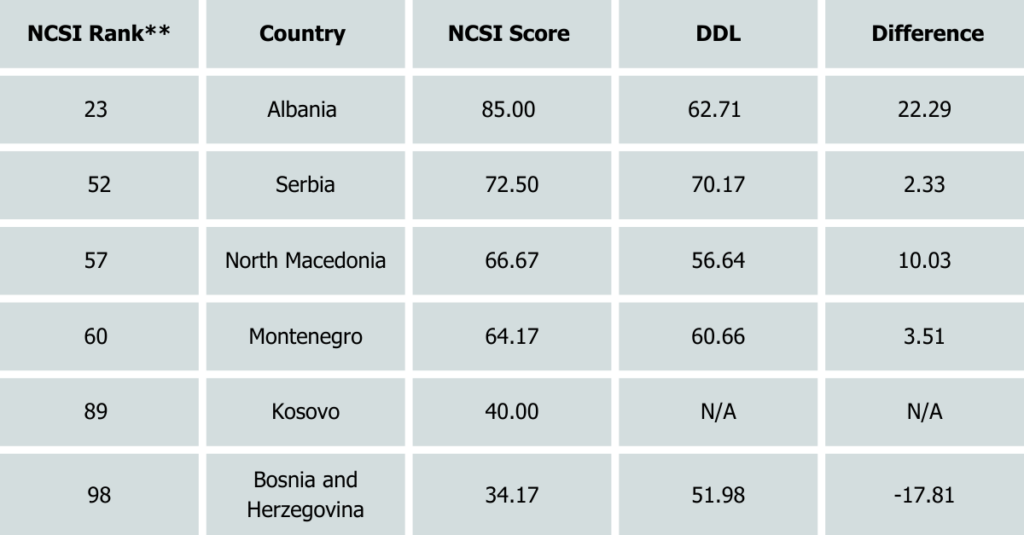
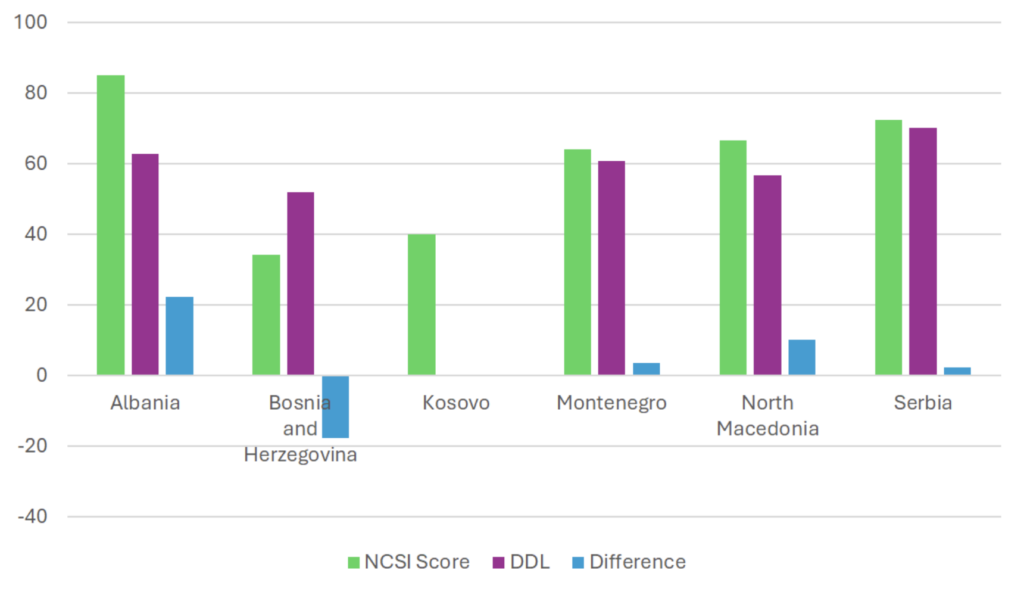
Additionally, the NCSI introduces the Difference, i.e. the relationship between the NCSI score and DDL. A positive result shows that the nation’s cyber security development is in accordance with, or ahead of, its digital development. A negative result shows, that the nation’s digital society is more advanced than the national cyber security area.
In Albania and North Macedonia, cybersecurity efforts seem to highly outpace digital transformation endeavours, while in Montenegro and Serbia, they are almost neck in neck, with a slight emphasis on cybersecurity.
Kosovo*** efforts in cybersecurity have been consistent throughout the years. However, due to the lack of their inclusion in the EGDI or the NRI, we are unable to measure their digital transformation and thus cannot infer the rest of the values and relationships dependent on the missing values.
Finally, Bosnia and Herzegovina’s cybersecurity accomplishment dwarf their digital transformation ones. Thus, their difference is negative and translating into an existing risk for their nation’s development.
Conclusion
By analysing established international benchmarks such as the EGDI and the NRI with the NCSI and its DDL metric, a more nuanced picture emerges, highlighting not only levels of advancement but also critical imbalances between digital growth and cyber preparedness.
While most countries in the region show a relatively aligned evolution of digital transformation and cybersecurity, others reveal significant weaknesses that may expose systemic risks as digital services expand. For the Western Balkans, leveraging best practices from the NCSI and KnowCyber platforms, can contribute to more resilient, secure, and sustainable digital societies.
*The EGDI focuses on UN member states. The assessed economies of the 2024 NRI do not include Kosovo. We are therefore unable to calculate the DDL for Kosovo.
**As of 10.02.2026, out of 143.
***This designation is without prejudice to positions on status, and is in line with UNSCR 1244/1999 and the ICJ opinion on the Kosovo declaration of independence.
Sources:
e-Governance Academy, 2026. National Cyber Security Index. Available here.
Portulans Institute, 2026. Network Readiness Index 2025 – AI Governance in a Global Context: Policy and Regulatory Approaches. Available here.
United Nations, 2026. E-Government Development Index (EGDI).Available here.
This article was created by
Radu Serrano, Expert at the e-Governance Academy