This article was created by
Kristiin Jets, e-Governance Academy
Share this article!
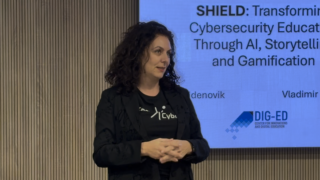
Traditional approaches to cybersecurity education often struggle to engage students. Rules can feel abstract, lessons repetitive and long-term impact limited. In North Macedonia, Center for innovations and digital education Dig-Ed set out to change this narrative by reimagining how young people experience digital safety education.
As a KnowCyber grantee, the Dig-Ed Center implemented the SHIELD project, an innovative approach that combines digital storytelling, AI-powered tools and game-based learning to empower both teachers and students and make cybersecurity education meaningful, engaging and memorable.
The starting point was a simple observation: students are often bored in the classroom and cybersecurity lessons are no exception.
“Cybersecurity is usually taught as a set of rules, and for students those rules can feel distant and abstract,” explains Maja Videnovik, Co-Founder of the Dig-Ed Center. “When learners don’t see themselves in the content, they disengage.”
Teachers echoed this concern. Many felt they lacked the tools and methods to make online safety lessons relevant, interactive, and age-appropriate. As a result, Dig-Ed identified several key challenges: low student engagement, limited long-term knowledge retention, lack of personalisation and a strong need for playful, real-world learning experiences.
To address these challenges, the Dig-Ed Center introduced a new learning model that turns cybersecurity education into an interactive experience. At its core is the SHIELD methodology, which blends:
Students follow relatable characters, face real-life digital dilemmas and solve cybersecurity challenges as part of a game-like journey. Homework becomes a mission, classroom discussion becomes problem-solving and learning feels closer to play than lectures.
“When students experience cybersecurity through stories and challenges, they learn without realising they are learning,” says Videnovik. “They remember more because they are emotionally and actively involved.”
A central pillar of the SHIELD project was teacher empowerment. Dig-Ed trained more than 40 teachers, equipping them with skills to design and deliver gamified cybersecurity activities using AI-supported tools.
“Teachers don’t need to become game developers or AI experts,” Videnovik notes. “They need confidence, adaptable tools and a framework that supports them. SHIELD was designed with that reality in mind.”
Through the EduGame-AI framework, teachers guided students through pre-tests, interactive learning sessions and post-tests, including a delayed assessment one month later. This step is rarely included in traditional training programmes.
The results confirmed the effectiveness of the approach. Testing showed significant improvements between pre-tests and post-tests, with long-term post-test results demonstrating the strongest knowledge retention among students.
Students reported higher motivation, deeper understanding of cyberbullying and online risks and greater confidence in knowing how to react in real-life digital situations. Teachers observed more active participation, richer discussions, and stronger connections between lessons and students’ everyday online experiences.
In total, the project reached more than 2,300 students and resulted in the creation of over 30 gamified cybersecurity activities, now shared within teacher communities and available for reuse.
Beyond immediate results, SHIELD established a scalable and adaptable methodology that can be applied across subjects, age groups, and education systems. Dig-Ed Center has since presented the framework at conferences, workshops, and to game developers, and continues to expand the model with new levels, challenges, and learning pathways.
“This is just the beginning of SHIELD,” says Videnovik. “We are building a growing community of educators who believe that digital learning can be safe, engaging and empowering.”