This article was created by
Kristiin Jets, e-Governance Academy
Share this article!

For years, the international community has recognised a strong and growing connection between digital violence and human trafficking. This link became even more visible during the COVID-19 pandemic, when daily life shifted online. While awareness of the problem exists, concrete patterns of how online abuse escalates into trafficking often remain poorly understood.
This gap was the starting point for ASTRA – Anti-Trafficking Action, a KnowCyber grantee working to make these patterns clearer through long-term evidence, survivor perspectives and targeted awareness actions in Serbia.
The project began with an in-depth analysis of ASTRA’s internal database, a task built on decades of frontline anti-trafficking work.
The analysis was based on data from ASTRA’s SOS hotline and the European Missing Children Helpline (116000) in Serbia, covering the period from January 2020 to mid-2025. Within this dataset, 925 records involving actual or suspected links between human trafficking and the use of digital technologies were identified. Based on these records, a sample of 123 cases involving adult and child victims, including both Serbian and foreign nationals, was selected for analysis.
This extensive review made it possible to identify recurring factors and recruitment mechanisms that often go unnoticed in public discussions.
“We knew the link existed,” says Tamara Vukasović, Deputy Director and one of the founders of ASTRA. “But we wanted to clearly show how digital violence turns into trafficking – step by step, pattern by pattern.”
One of the clearest findings was that in over 85% of cases involving a digital dimension, digital technologies were used for recruitment into human trafficking, forced labour and similar practices, mainly through deceptive job offers and fraudulent opportunities on digital platforms.
In many situations, traffickers used social media, messaging apps or online marketplaces to normalise exploitation before victims even realised they were at risk.
Beyond fake job offers, the analysis revealed a recurring and particularly dangerous modus operandi: grooming and the so-called “loverboy’’ method.
In these cases, traffickers establish emotional relationships online, gradually building trust before introducing digital control mechanisms. One survivor described how her partner encouraged her to install an app “to support the relationship.”
Instead, the app enabled constant monitoring, location tracking and control, a form of digital violence that escalated into trafficking over time.
“This is how exploitation often begins today,” Vukasović explains. “Not with violence, but with trust and digital control disguised as care.”
All 23 cases involving missing children resulted in confirmed exploitation, most often sexual exploitation. Digital platforms played a crucial role in grooming, recruitment and control in all cases.
Despite multiple institutions being aware of the children’s disappearance, responses were fragmented and largely failed to integrate digital risk assessment. Digital forensic tools were rarely used, and digital violence was frequently overlooked in legal qualification and protection planning.
Alongside data analysis, ASTRA collected survivor testimonies to ensure that real-life experiences shaped the project’s outputs. These narratives help young people, educators and professionals recognise how trafficking unfolds in practice from the first online interaction to coercion and exploitation.
Based on these testimonies, ASTRA developed case studies that clearly demonstrate how seemingly ordinary digital interactions can evolve into trafficking situations. The goal was to move beyond abstract warnings and show what these patterns look like in real life.
“Survivor perspectives help others recognise the warning signs earlier,” says Vukasović. “They make the risk tangible.”
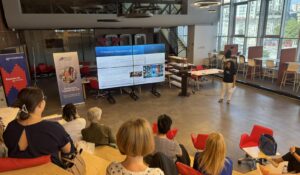
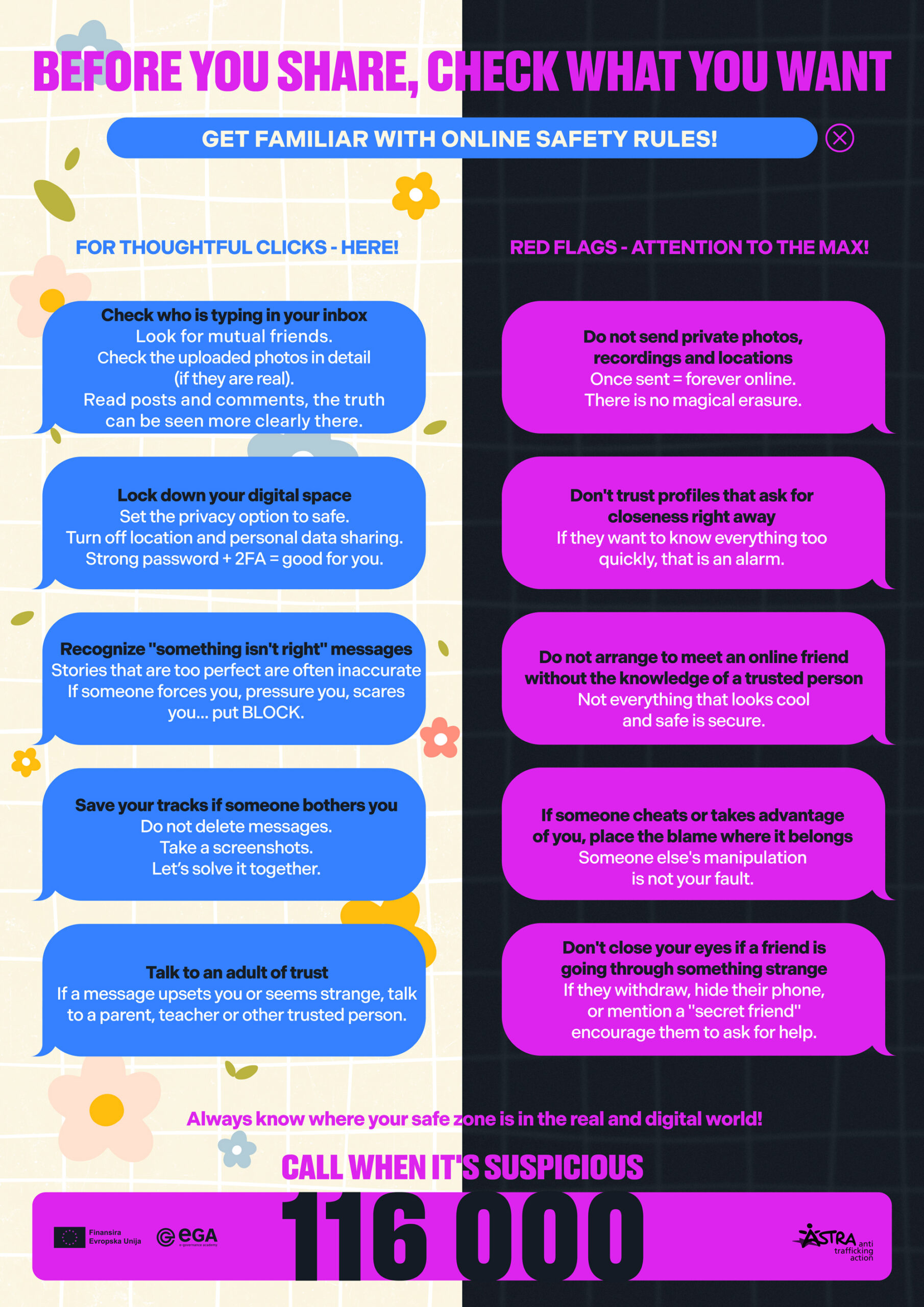
Using insights from the research and testimonies, ASTRA launched a two-track awareness campaign:
These efforts were designed to help different audiences understand their role in preventing digital violence and trafficking.
The findings from ASTRA’s research highlight the urgent need to:
Most importantly, the project helped build a shared understanding that digital safety and anti-trafficking work must be addressed together.
“This cooperation is one of the most important outcomes,” Vukasović concludes. “When experts from different fields start working together, prevention and interventions becomes much stronger.”
As ASTRA’s work shows, online violence and trafficking are deeply interconnected and often hidden in plain sight. Awareness, reaction and support can interrupt this cycle.
“If you see violence online, don’t ignore it. Report it. React,” Vukasović urges. “Your reaction matters and it can protect someone from harm.”
Through evidence, survivor voices and cross-sector collaboration, ASTRA’s work contributes to stronger protection for vulnerable groups and a clearer understanding of how digital spaces can be made safer for all.